
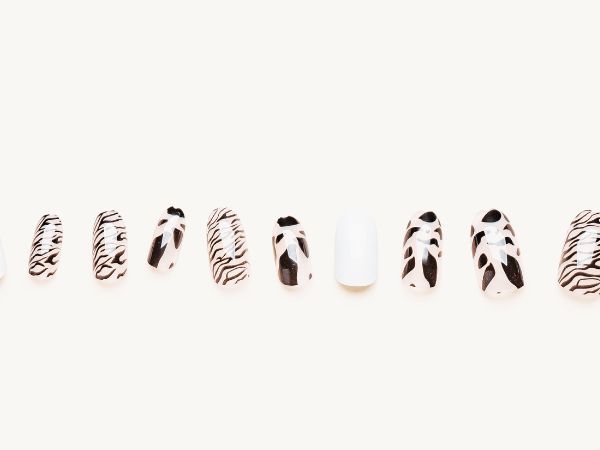
Une mode à récemment fait son apparition, une vague tout droit venue des États-Unis : le Press on nails appelés aussi ongle press en français. Connaissez-vous cet engouement dans l’univers de la manucure et de la beauté ?
Cela permet de faire s’abstenir à faire appel a une esthéticienne et vous permet de réaliser sa manucure soi-même en quelques minutes seulement. Pas besoin non plus de passer des heures devant un tutoriel nail art.
Comment ça marche ? Quels avantages ? Quels styles ? Le prix ? Les marques (Roxy Nails, Nails Paris…) ? Prenez quelques minutes pour lire la suite.
Sommaire de l'article
Press on nails : c’est quoi ?
Il se traduit littéralement par « presser sur les ongles ». Cela représente bien ce qu’ils sont : un kit de faux ongles à collés sur vos ongles !!
Les kits d’ongles sont préparés et décorés (selon différents styles) pour être collés (pressés) sur les ongles naturels. Populaire depuis des années aux États-Unis, depuis le confinement en France, ils sont devenus presque un incontournable dans le monde de la beauté des ongles.
Les ongles press sont des donc des sortes de capsules/faux ongles qui se collent directement sur les ongles naturels, sans nécessiter l’utilisation de produits chimiques ou d’outils professionnels. Les matériaux dans lesquels ils sont fabriqués sont le plastique ou l’acrylique et ils sont recouverts d’un vernis de finition avec un rendu de votre choix.
Quelle durée ?
Les techniques d’application actuelles ont une durée qui va de 1 à 2 semaines. De faux ongles autocollants qui se gardent presque deux semaines, c’est vraiment très pratique !
Les avantages des ongles press : gain de temps et praticité

Des manucures faciles à réaliser en un clin d’œil
Seule à la maison et sans expertise d’esthéticienne, vous pouvez en moins de dix minutes (top chrono !!) réaliser une manucure complète.
Il suffit de choisir le taille des capsules, d’appliquer une fine couche de colle ou de gel pads ultra-adhésifs sur l’ongle naturel, puis de presser fermement la capsule pendant quelques secondes. Pas de temps de séchage, pas de risque de bévue, vos ongles seront parfaits et prêts à sortir.
Un large choix de styles et design
Des plus classiques aux plus audacieux, les ongles à presser sont disponibles dans une grande variété de modèles et de styles. Grâce à eux, vous pouvez changer de look instantanément, adapter votre manucure à n’importe quelle occasion et changer de look en un clin d’œil. De la french manucure au nail art coloré en passant par les ongles en gel à effet miroir, il y en a pour tous les goûts. Vous allez pouvoir vous faire plaisir au rythme de vos envies, même les plus fantasques.
Réutilisable
Ces faux ongles sont réutilisables, oui vous avez bien entendu : réutilisable !!! Dans la mesure où vous les entretenez correctement, vous pourrez les porter plusieurs fois. En fait, vous pouvez le retirer après quelques jours, nettoyer les résidus de colle et le remettre dans sa boîte d’origine jusqu’à ce que vous soyez prêt à le revêtir à nouveau. Super méga pratique non ?
Quel prix pour un kit de press on nails ?
Pour vous donner une idée, il faut compter environ entre 15 € et 40 € pour un kit complet comprenant : ongles, colle, accessoire nécessaire à la pose.
Certaines marques proposent également des kits contenant plusieurs sets de capsules, ainsi que des sizing kits permettant de déterminer sa taille d’ongles avant l’achat.
Les marques
Roxy Nails Paris : des ongles chics et tendance
Une marque française qui propose une large gamme de design, une collection qui se renouvelle sans cesse ou rythme de nouvelles modes (notamment en matière de nail art). Les prix varient entre 20 et 35 euros pour un set de 24 ongles. Ils ont une offre 2 achetés = 1 offert.
NailistAddiction & Co
Les amateurs de Press on Nails trouveront en NailistAddiction & Co la destination idéale. Un lieu dédié à ces petits bijoux, où la qualité et le fait main sont les maîtres mots. Des Press on Nails haut de gamme pour une manucure soignée et tendance digne d’un salon professionnel. La livraison peut etre gratuite dans certains cas.
Comment retirer des press on nails ?
Trempez vos doigts dans de l’eau chaude pendant environ 10 minutes pour ramollir le vernis, ce qui vous permettra de l’enlever facilement. Vous pouvez également acheter des solutions pour enlever le vernis à ongles. Notre article détaillé vous expliquer comment retirer des Press-on nail de la bonne manière.
Comment appliquer des press on nails ?
Pour appliquer des press on nails correctement, commencez par nettoyer et sécher la surface de l’ongle. Ensuite, enlevez le film protecteur et appliquez l’ongle à la base de l’ongle naturel, sans trop appuyer. Utilisez ensuite un petit outil pour presser fermement tout autour de l’ongle pour le fixer en place.